Epoxy, space heaters and cradles
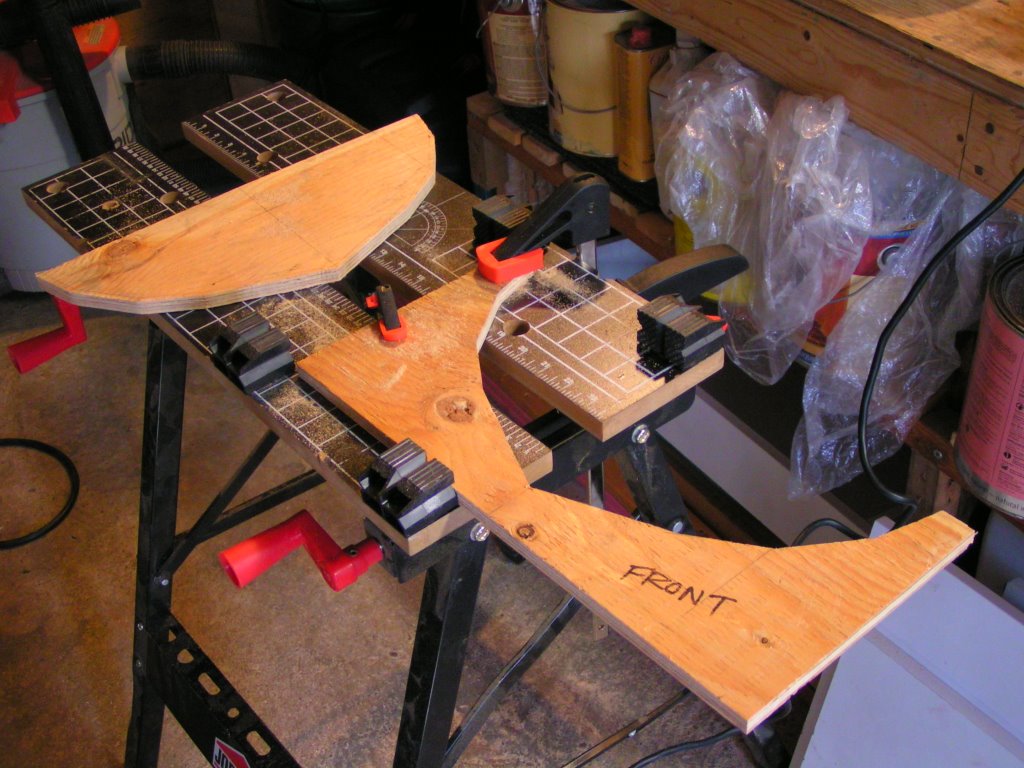
I have been playing around lately with the epoxy that came with my kit and I have discovered that my shop is too cold right now to work with it properly. I will talk more about this problem later. Rather than fight with trying to apply very viscous epoxy to my butt-joints I have decided to take the advice given in "Kayaks you can Build: An Illustrated Guide To Plywood Construction" (see my last post) and fabricate 3 cradles to help in supporting and assembling the hull panels later on. This process is perfectly described in the book, so I will not get into the details here. Briefly, it involves tracing the shape of the bottom two thirds or so of the 3 strongbacks supplied in the kit on a piece of 1/2" or 3/4" plywood, enlarging the outline by the thickness of the kayak's plywood panels (I used a scrap piece of this wood place on edge against the original outline and traced around it to give me the right thickness), then cutting out the cradle form with a jigsaw. Keep in mind that the point where the keel will sit in the cradle must be the correct height from the base to reflect the curvature in the keel. If you don't have a clue what I am talking about or even if you do, you need to read the book.
 Now back to my temperature problems. My friend Doug and I have been discussing this issue for some weeks and we have not really come up with an ideal solution yet. What has worked best is to leave a cheap ceramic electric heater running in the garage all the time (here in Vancouver this costs less than $1 a day!). In my case this gets the temperature above 10C (50F) even when it is below freezing outside. This seems to allow me to spread the epoxy mix with few problems as long as I warm the epoxy components and mix before I apply it. If it is too cold I get tons of bubbles in the mix and it is harder to wet-out the fiberglass or saturate the wood. Imaine trying to apply think honey to toast. I also have found that a small, natural bristle artist's brush is easier to use than the foam brushes that Pygmy suggest. I have a lot more control when spreading the epoxy and I find it much easier to clean the brush with acetone or vinegar. With the foam, I was having to throw the brush out after each use because they were impossible to clean.
posted by Mark Ware @ 1:00 AM
0 comments


0 Comments:
Post a Comment
<< Home